“Almost Not Afraid at All”

I’ve been reading the “Tuyo” book series by Rachel Neumeier. It’s a fantasy series that takes place in a world where each region is separated dramatically from the next, with each region having its own extremely different weather, sky, peoples, customs, etc. I probably enjoy these books so much because they are very cross-cultural, as the people in these regions rarely interact, but the main characters are forced to leave their home regions and live among and befriend people who are completely different from them. 

One of my favorite characters is Tano who is rescued from a very abusive family/tribe situation. He is brought into a new tribe where he is treated well for the first time in his life and he slowly learns the things he needs to know to be a part of this new people. He struggles with a lot of fear and lack of trust, but he’s determined to overcome in these areas so he keeps pushing himself to do things that he logically knows are good for him, even though, physically and emotionally it terrifies him to try it. As he grows in these areas, and his fear lessons, he uses a line quite a lot, “I was almost not afraid at all.” 

I like that. I think that sums up how I live a lot of my life. Growing up cross-culturaly, I always struggled with not fitting in and the fear that evoked. I never quite knew all the customs and ways of doing things. I mostly got it, but there was always something that would make me take a misstep, draw attention to my ignorance, which generally drew mockery. I learned to get really good at observing people carefully and taking my cues from them. Every new situation felt fraught with danger. I don’t know where I’m supposed to go. I don’t know what I’m supposed to say. I remember in 8th grade we had been living in Haiti and due to the major upheaval and violence happening in the country, we had to leave and come back to the States. I came into middle school four months into the school year. At lunch everyone got in line to get their food. My mom offered to give me lunch money, but the idea of having to figure out where to line up, how to pay for my food, how to figure out the whole system, was too overwhelming for me, too many opportunities to mess up and draw negative attention. I just skipped lunch the rest of the school year and then ate a big snack when I got home from school every day. 

As I got older I was able to recognize that a lot of these fears were unreasonable. So, I would make myself do things that felt scary, but logically I knew I should/could do them. Fake it till you make it. I got good at walking into situations and being upfront about my ignorance. Hey, I’ve never done this before, could you show me how this works? I have also learned how to over-prepare in order to cancel out some of the fear. I’ll look at maps ahead of time so I know exactly where I will park, and exactly how long it will take me. Maybe I’ll write down notes on questions I need to ask, information I need to remember to get. Possibly I’ll talk through the whole scenario ahead of time with my husband, ok, so I’m going to do this first, and then this, and then this…does that sound right? I’ve learned to just do the things that make me afraid because the fear is unreasonable and things need to get done. 

This week I had a job interview. I can’t remember the last time that happened. All the things I’ve done on the side to make some money over the years have been initiated informally, by someone I know or a friend of a friend. So, extremely new experience. It was at a location I’d never been to with people I’d never met. (It’s a part time position, teaching a one-hour children’s music class once a week.) 

Ahead of time, I was expecting that I was going to be nervous. I was anticipating being nervous. I was ready to be nervous. But, a couple hours beforehand, I thought about it and realized that I was actually excited. Not nervous. I was curious and actually looking forward to meeting these new people and discussing the class. Yes, my heart was pounding a bit, and I took a couple deep breaths before I got out of my car, but practically nothing! 

The interview went fine. I’ll find out next week whether they want me or not. But, getting the position almost feels irrelevant. I feel like it was a big win to do something new where I wasn’t scared and actually enjoyed myself. I did something new, and “I was almost not afraid at all!”

1 John 4:18 says, “There is no fear in love, but perfect love casts out fear. For fear has to do with punishment, and whoever fears has not been perfected in love.”

My journey to overcoming fear is directly linked to my understanding of how much I am loved by God. The better my understanding, the less fear I have. I look forward to a day when I will not be afraid at all. Until then, I’m pretty excited about “Almost not afraid at all.”
Blog Refresh

I’ve been writing this blog for quite a while now, but this past year I pulled back a lot on the personal blogs and have mostly just written about our free house. It was a needed break, and felt like something God-lead. Now I am feeling like it might be time to start writing again. A lot of things have changed since I first started this blog in 2018 and now I feel like I need to do a re-introduction. So here goes.

I am a missionary kid. I grew up in Eastern Kentucky, Haiti and bush Alaska. My husband is also a missionary kid who grew up in Nicaragua. When we first got married we spent some time in Alaska and Chile and then settled down in East Tennessee. We have ten kids. (And one daughter-in-law!) Four of our kids are adults and have left home and I am proud of them, and miss them a lot. I’ve got six kids left at home ranging from age nine to eighteen. Though we have homeschooled in the past, my kids are now all in school. I teach piano lessons and help teach choir at my younger children’s school. And then I keep the house running for eight people. 

I love reading. I am the quintessential bookworm, have been since I was in second grade. My husband also loves reading and we’ve managed to pass this down to most of our children. A cozy evening at our house often looks like a bunch of people sitting around on couches reading books. 

This past year our family was gifted the house next door. Turned out it was a hoarder house, so now we have slowly been cleaning it out. My husband works in the construction industry, so this is right up his alley. We look forward to eventually restoring the house and making it usable again, and posting updates about that project on this blog has been motivating for me. 

If you want to know the foundation blocks of who I am, I would say, I was a broken, lost person who has been rescued by Jesus. Every moment of my life has been an example of his grace and mercy. He has saved me from my desperate places, and has slowly but surely been leading me down a path that leads to life and wholeness and joy. There’s been a lot of bumps, holes, rocky places, dangerous cliffs etc, but I can say confidently, that Jesus’ hand has been on my life since I was conceived and he has held me fast and brought me through, and continues to bring me through every challenge, pain and danger that life has thrown at me. 

Walking with Jesus does not mean that you live a charmed life with minimal challenges. It rather means you live a victorious life as you have God himself walking with you through each hardship that comes your way. I have my own grocery list of challenges I deal with regularly. Anxiety and depression. Fear. Self-righteousness. Self-centeredness. Fear of rejection. I can look back and see how I have improved greatly in all these areas, but every once in a while one or more of these will make themselves center-stage in my life again and I have to put into practice the things I’ve already learned and also learn more about how to overcome in these areas. 

This blog is an invitation for you to come walk with me through everyday life and see up-close and personal what walking with Jesus looks like. The good, the bad, and the ugly. 

I look forward to connecting with you all again!

The Complicated Emotions of an American Citizen

When I was a kid, I lived in Haiti. My parents were missionaries. I lived in Haiti from the age of two to six and then from eleven to fifteen. I was in Haiti in the early 1990’s and was living there during the 1993 UN arms and oil embargo. It was the UN, but my understanding of it as a young teen, was that it was the United States who was pulling the strings to make the embargo happen. 

I watched Haiti be punished by the United States in a way that boggled my young mind. No fuel. No gas for cars and trucks to drive. No way for supplies to get transported to where they needed to be. No food for sale. No electricity. I remember my mother, who worked in the medical field, saying that she could no longer buy the medicines she needed for her patients.  The pharmacies simply didn’t have any to sell. I remember our family rationing our fuel so we could turn on our generator every three days for an hour so that our water pump would work so that we could fill up buckets and vessels with clean water to get us through the next three days before we turned our generator on again. I remember riding my bike to school instead of getting a ride from my parents. I remember our food was very limited and we lived off the canned foods that had been sent to us in care packages. I remember knowing that if we, the rich Americans were struggling, there was no word to describe what the average Haitian was going through. I remember how stressed all the adults in my life were. I remember how fragile and precarious it felt to be an American living in a country that was currently being oppressed by the United States. 

And I was ashamed to be an American. Not only that, I was angry that I was an American. It felt like a curse. Let me be anything but a rich white American who goes around bullying the world however they please, with no care whatsoever for the people they are affecting. 

We came back to the States the summer of 1994, right before Haiti was invaded by the U.S. When we got back to the States we spent a couple of weeks traveling around visiting churches. Our family was not in a good place mentally or emotionally. It was very hard to step from Haiti where people were starving, struggling to survive, suffering; to step from that to middle class America where everyone was healthy looking, well-dressed, well-fed, living in beautiful homes with shiny cars parked outside, and still finding something to complain about. 

Then, the Fourth of July showed up, and it was close enough to a Sunday that the church we were visiting planned a Fourth of July themed service, and they asked my Dad to preach. For the Fourth of July service. I was dumbstruck. How on earth was my Dad going to preach a Fourth of July sermon?? My Dad had just lived through the horror that the United States imposed on Haiti. He was just as angry as I was. Probably more. 

I always enjoyed hearing my Dad preach, but this time, I was on the edge of my seat, waiting to hear what he would say. 

My Dad, stood up on the stage and he preached about what our nation was founded on. The goodness that could be found in our country. He did not say one negative thing. Once. I was listening for it, waiting for it, it never came. And my mind boggled. How could he do that??? How could he say positive things about our country? I think, afterwards, when our family was alone, we questioned him on it. And he said that everything he talked about was true. Even if we couldn’t see it at work at that moment, it was still true. 

That was one of those defining memories. As a kid everything is black and white, good or bad. No gray areas. And it was the first time I had to grapple with the idea that something could be both. That a country could still be considered good, founded on righteous principles, even when those principles were not always very evident. 

I still occasionally struggle with being an American. I’m old enough and have seen enough to know that I don’t desire citizenship in a different country.  I’m very comfortable with being an American. I get a lot of benefits from my citizenship. I have come to love my fellow Americans. But there are times when old feelings get stirred up. Elections have a way of doing that to me. 

Over the past couple weeks my brain has written and erased hundreds of social media posts. I have mentally written diatribes and stopped myself from typing them. I have thought out replies to other people’s posts and then stopped myself from answering. But I still feel the need to say something. To address this political moment that we have all just lived through. 

And so, I am going to take a page from my Dad’s book, and talk about the good in America. I am thankful that I was able to take part in an election. I am thankful that legally as a woman I have equal rights with men. I am thankful for my city and the way that it is run. Every day I see people collecting trash, repairing roads, maintaining electric lines, delivering mail, police and firemen and ambulances responding to emergencies. I am thankful for the generosity of the American people. We are a nation that gives to causes. I am thankful that I can go to whatever church I want, whenever I want, and worship how I want. And I’m thankful that other religions are free to practice in our country as well. I am thankful for how diverse we are as a people, everyone with a unique family history. I am thankful that I can educate my children how I please, whether it’s homeschooling, private school or public school. I am thankful for the beauty of this country and the national and state parks that give us a place where we can enjoy that beauty. 

Our country is a gray place. We are founded on righteous principles, but we have yet to reach a time where we are fully walking out all those principles. But I have hope. The good is there, and I will continue to look for it and find it and be thankful for it. 

Upstairs Downstairs Truth

I’m reading a book called “The Deconstruction of Chrisitianity: What it is, Why it’s Destructive, and How to Respond” by Alisa Childers and Tim Barnett. I’m only up to chapter 7, but it’s been a good book so far. 

In the book the authors acknowledge yet another author, Francis Shaeffer, who came up with the concept of upstairs and downstairs truth. And that’s what I want to talk about. So, the idea is that in this stage of history that we are in, we have come to organize truth in a two story house. On the bottom floor are things like science and math. Facts. These are unarguable, unmovable. 1+1=2. No one is going to reasonably argue with that. Then, in the second story of our house we have things that fall more into the category of preferences. I think chocolate ice cream tastes better than vanilla. I like Fall better than Winter. Green is the prettiest color. These are opinions and are going to be different for each person. You like green, but I think purple is better. So far so good. The problem arises in that our society has placed religion in the upstairs part of our house. You believe in God? Ok, that’s fine. I don’t. But, whatever makes you happy. Which, maybe you’ve seen that COEXIST bumper sticker that uses each letter of the word to represent all the world’s main religions? The idea being, you believe in Allah, and I’ll believe in Buddha, and they can believe in God, and we can all be happy together and support each other in our preferential beliefs. 

Except that, as Christians, we believe that our faith belongs in the downstairs part of the house. Jesus is real, his word, the Bible is unarguable truth. Jesus said, “I am the way and the truth and the life, no one comes to the Father except through me.” John 14:6. We don’t believe that religion is preferential. If you don’t believe in Jesus then you are not saved. This is unarguable fact, like 1+1=2. 

I’ve been thinking about my own faith journey. I had some traumatic events when I was very young and my response was to retreat into my own little world of imagination and books. But, even at that age, I knew Jesus, and I took him with me into my own little world. I remember when I would daydream and create stories in my head, there was always that standard that my stories I made up and lived out in my fantasy world (stories that helped me makes sense of the world I was living in and make sense of the things that had happened to me), those stories always acknowledged the presence of God. And when I think back on the theme of most of the stories I made up, the heroes I imagined were very Christ-like. 

As a child who grew up on the mission field and whose parents were in full-time ministry, I saw a lot of the bad side of organized religion. I saw hypocrisy, abuse, and more hypocrisy. I saw a lot of legalism. Manipulation. Essentially, a whole array of things that should have turned me away from my faith. Things that should have made me think, well, if that’s what Jesus is like, then I don’t want anything to do with him. And here is where my testimony is, my story of how God kept me from falling away. Somehow, Jesus made himself known to me at such a young age and was so a part of my inner thought life, that when I saw all these things that were wrong, I knew that those things were not Jesus. Those things were people acting in such a way that proved they obviously didn’t know the true Jesus. 

I have known since I was very young that Jesus is fact. Not a preference. He is the truth and everything else is measured against him and his word as found in the Bible. And when Christians don’t act in a Christ-like manner, I know it means they’re not walking in step with Jesus, not that Jesus doesn’t exist. 

Reading about the Upstairs Downstairs method of organizing truth has been really helpful for me to understand where people are coming from when they approach religion as being a subjective experience. And it also helps make sense why people can get so angry about “fundamental Christians”. If my viewpoint of the world is that Jesus is a flavor of ice cream that I can choose to like or not like or just ignore if I want to, I can see how someone standing there telling me that Jesus is the only way would feel annoying. I pray that the Holy Spirit will move and open people’s eyes to see that Jesus is fact not preference, that he is Truth, not opinion. 

Ramen Noodles

It’s funny how certain foods are like portals to the past. As soon as you take a bite you are immediately back in an old memory. Ramen noodles do this for me. I don’t eat Ramen very much. I’m aware it’s not the healthiest option on the planet. But, occasionally, I will get Ramen for the kids (they rarely get it, and for some odd reason, have decided it’s a treat). I ate a packet for lunch today and as soon as I smelled the rich broth, I was floating back in time.

Fifth grade. Morehead, Kentucky. 

I think this was the first year our family stumbled on this amazing food. By this time my brother and I were latchkey kids. Our parents were working, and my mom was finishing up her last year of school to be a Physican’s Assistant. A save-a-lot had moved into town and my mom would stock up on freezer meals and fast foods that my brother and I could prepare for ourselves. 

Every day after school I would walk into the trailer, put the old copper kettle on. I’d pull out one of our orange bowls that had a white lining, bowls that had followed our family everywhere we lived,  and I would make myself a bowl of ramen noodles. 

I was always starving after school. Fifth grade was the year I stopped eating lunch at school. When we first moved to this school, I was in second grade and my brother was in fourth. My parents would send school lunch money with my brother and he would pay for both of us. We ate school lunches for about two years, but we didn’t really enjoy them. They served a lot of Southern American food that we just weren’t used to. Pinto beans and cornbread, corndogs (what was this thing?? I always pulled the corn breading off and ate the hotdog), really cheap hamburgers that had some kind of weird slime on them, mashed potatoes that were so runny it was almost more like a porridge. (There was one meal that I actually liked, beef vegetable soup and a bread roll.) 

When I was in fourth grade, we moved away for one year while my mom did an intensive year of study at the University of Kentucky in Lexington, then we moved back to Morehead. I was now alone at my school, my brother had moved on to middle school, and I had no idea how to navigate school lunches. Who did you pay? When did you pay? How much? It just seemed like an overwhelming problem, overwhelming because everyone else already knew what to do, and here I was, in 5th grade, clueless. 

Just an aside. This has long been a problem for me. My mother is British and grew up overseas, my father is American but he grew up overseas. I did not move back to the states till I was almost seven. And we moved to Eastern Kentucky that has its own unique culture going on. I spent a lot of my childhood not knowing what everyone else already knew. I would try to be very observant, see what everyone else was doing and copy them. Or just retreat. Or pretend like that was just not something I wanted to do, cause I had no idea how to go about doing it. Sometimes I would brave being made fun of and just ask, but other times, it seemed like too much energy to try and figure things out. And for school lunches, It was just easier to not buy any. 

So, I told my mom I would take a lunch. And then, I just didn’t. I didn’t like packing lunches. In fourth grade I got teased quite a bit because I would pack a lunch and bring food that was not “normal” like a whole tomato that I would eat like an apple, or a piece of bologna, and piece of bread, packed separately, cause that’s how I liked them. Somewhere along the way I just decided school lunches were not worth the hassle. So, I would sit at a table and wait a couple minutes until I could just line up with the other kids and wait to leave the cafeteria. I always had a book to read, so I wasn’t bored. 

Then I would get home, starving and eat Ramen noodles. And cereal. And whatever else was laying around the house. 

I’m not sure what kind of memory that is. But, I’m thankful for those hot hearty noodles that made me feel full and satisfied after a long day at school. 

The Old Trailer

When I was a child, my grandparents owned a forty acre farm in Eastern Kentucky. It was in Knipp Hollow (prounounced hollar). Morehead was the closest town. My grandparents owned the old farmhouse that was down by the main road, at the mouth of the Hollar. My Uncle had been given a piece of land on top of the mountain (just a large hill, but as a child, walking up the gravel driveway to the top in the summer, it was a mountain), and my parents had carved out a terrace a little ways up the hill and also had access to a large field down by the creek where we planted a big vegetable garden every summer. 

Our family came and went from the missionfield, but two different times, when we were stateside, we lived in the little trailer perched on the side of the mountain, surrounded by pine trees. There were giant pine trees that grew all over the hillside in front of our home, so tall you strained your neck to see all the way to the top. I was told that my great grandfather had planted those trees. Then the hillside behind our home was covered with smaller pinetrees, all about the size of beautiful Christmas trees. My parents told me they planted those trees the year I was born and I felt the kinship of being the same age, having the same birthday as those beautiful trees. I would often scurry up the embankment behind our trailer and burrow myself in the trees. Invisible to the world, in my own little nest. 

Our trailer was a singlewide (none of those bourgeois doublewides for us). It was white and yellow and green. Old. Creaky. A stove pipe stuck up from the roof and there was alo a large onion-shaped oscillating vent, meant to keep things cooler in the summer, but far too inadequate for the job. In the winter my dad would stuff insulation up in the vent in order to make everything as air tight as possible. He would cover the old one-pane windows with thick plastic sheeting, held in place with silver duct tape, and our dear old Ben Franklin wood stove would work tirelessly all winter to keep us warm. To this day, when I smell woodsmoke, I’m instantly transported back to that old trailer. 

When I was a baby my parents had built a large covered porch that ran almost the entire length of the trailer. It was made with two by fours, and thin logs I presume my dad had taken from the woods. The roof was made out of green fiberglass roof panels. Translucent enough that a beautiful green light came through. There was a railing around the entire porch that was filled in with what looked a bit like plastic coated chicken wire. All the spaces were filled with wire because apparently, when I was a baby, the porch was my favorite place to play. Because the trailer was on the side of a steep hill, the porch hung out into the air and there was room under the porch for kids to play if they felt like it. Many a summer day found me under that porch, digging around in the cool dirt, making fancy mud pies with my little tin dishes. 

The trailer had three bedrooms. A separate room each for me and my brother on one end of the trailer and a room for my parents on the other end of the trailer. The rooms were so small. My brother and I each had a bunk bed and a dresser in our rooms. I had enough space to open my drawers and a narrow path from the doorway to my little corner closet, and that was it. It was truly a bed-room. A room for my bed. Nothing else. When I played in my room, I sat on top of my bright patchwork quilt on my bed to play. There was no floor room. I had one window that looked out onto the hill rising almost straight up behind us, only feet away, covered with all my pine trees. Not much of a view, but it felt cozy to me.

The walls of the trailer were all dark, fake wood paneling. Just google images of “wood paneling 70s and 80s” and you will see exactly what I mean. The old shag green carpet had been torn up and replaced with a beautiful beige, but really you could hardly see the carpet because the furniture covered everything. The living room was tiny but it had a large couch, a buffet with a large tv covering half of it, a big bookshelf that sat on top of a small cupboard, a dining room table and four chairs. The next room was the kitchen. Yellow linoleum. Yellow fridge. Brown wooden cabinets and yellow formica counters. The woodstove took up half of the floor space of the kitchen. Then down a narrow hallway, made even more narrow by all the coats hanging up on hooks on one side, a bathroom just big enough to hold a yellow tub, more yellow formica, yellow linoleum, and an old washer and dryer. You could only access the washer if you went all the way into the bathroom and closed the door. Then finally my parents room at the end. 

During my childhood I lived in twelve different homes. The trailer was probably the most humble one, but it’s the home I remember the fondest. Cozy, warm, bright and cheerful. Tucked safely in the woods, deep in the hollar, surrounded by tall hills and trees, a creek at the bottom of the hill. I count myself a rich woman to have had that as part of my childhood. 

The Old Brown Buffet

When I was going into second grade, my family moved back to Eastern Kentucky from the missionfield. We moved back into an old trailer my parents owned, sitting on a mountainside lot on my grandparents’ farm. 

I remember some of the bustle as my parents tried to freshen up the trailer for living again. The old carpets were torn out. I remember going to a giant warehouse filled with giant rolls of carpet. Feeling each one as we walked past, wondering which one we were going to have. I remember the carpets getting laid down in the trailer, how clean and bright they made everything look. I didn’t want any furniture to ruin this perfect carpet. I remember rolling around and revelling in the softness and newness of it all. 

I remember visiting an auction held in a giant barn out in the middle of a field. I remember the auctioneer’s voice going through the call for bids and how wonderfully entertaining it was to just listen to him go on and on and on in his sing-songy voice. I remember that an old solid couch came home from that auction, took up one wall of the living room. 

We also had some new furniture. A shiny round glass top table with four square, modern looking wicker-type chairs with shiny chrome metal as their frame. 

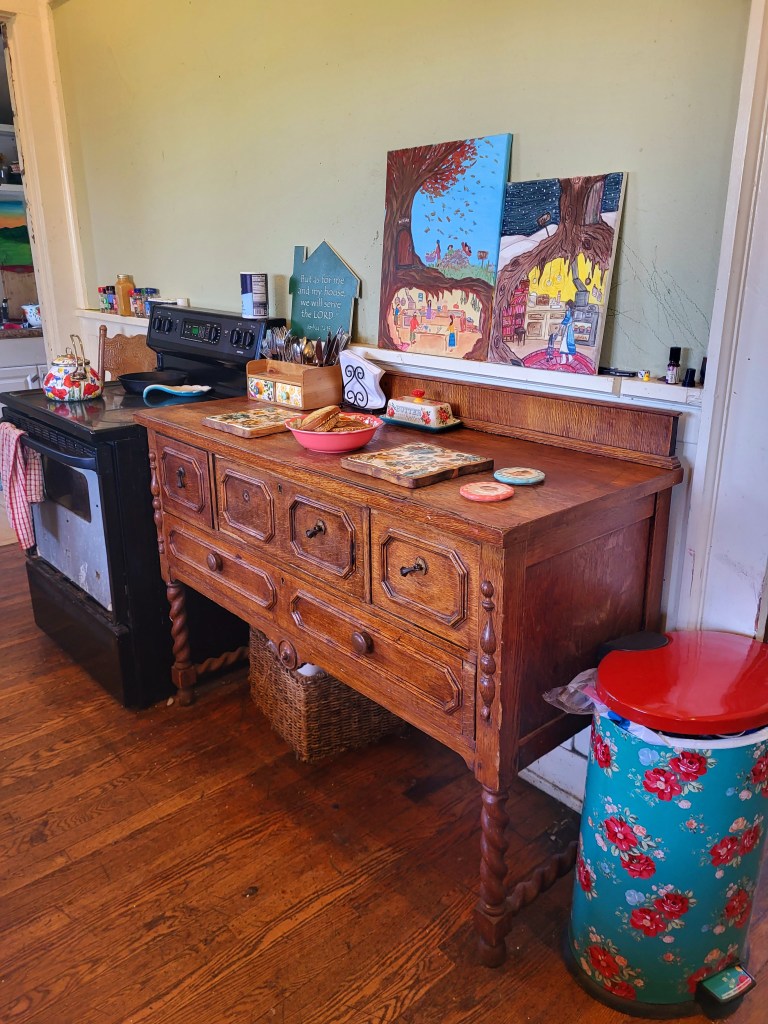
And then there was an old brown buffet. I don’t know if we also got it at the auction or if my parents picked it up somewhere else. It was definitely not new. But it was warm, brown, solid. A cheerful addition to our mix of furniture. 

It sat in the corner of the living room. I think our TV sat on it. It had three drawers across the top and a long drawer underneath. We kept something in it that we used regularly. Maybe our cloth napkins and tablecloths? I can’t remember exactly, I just know that I had to open those drawers regularly, and they were always a pain to open. The drawers were stiff and if you didn’t pull it out exactly straight they would jam and stick. 

Once a week my mom would assign cleaning chores and I remember her handing me an old cloth and a can of “Pledge” cleaner that I would spray on that buffet and then wipe industriously with my cloth. Watching as the wood took on a soft shine.

I have a vague memory of perhaps being on top of the brown buffet when my parents weren’t home and my brother and I were playing some involved game that made it necessary to not touch the floor. (Ground is lava perhaps?)

The brown buffet did not necessarily play a significant  role in my childhood, I just remember it being there. When we moved back to Haiti the brown buffet went into my parents storage shed that sat on my grandparent’s farm. 

After I got married my husband and I eventually settled into Eastern Tennessee. When we purchased our first house we drove up to Kentucky and raided my parents storage shed. The brown buffet came home with us and settled into our dining room. That was about seventeen years ago. The brown buffet has sat in our dining room ever since. 

It is truly a buffet now. Every meal time, three times a day, I lay out the food on the brown buffet and serve the small children their plates from there and then the older kids serve themselves. In the mornings I lay out the bowels and the boxes of cereal on the brown buffet and kids serve themselves. Our silverware has a special container and it stays there permanently. 

Now that my dining room is also my kitchen, the brown buffet has become one of my counters. I lay my electric griddle on it so I can make pancakes. I set my various containers of food on it while I prepare a meal on the stove that sits right next to it. In the afternoons I put out bowels of fruit for the kids or plates of cookies. 

The drawers are still a pain to open so I try to only keep things in there that I don’t need to access regularly. I’ve got a drawer of old framed photos. A drawer of random decorating knick knacks I don’t use anymore. The bottom drawer holds all of the random odds and ends that my husband and I picked up on our international travels. Carved wooden statues from Haiti, tin cars from Nicaragua, pan flutes and a miniature chess set from Chile. Any time my kids need something international for school, the drawer opens and we dig around. I even have some things from my mom’s childhood in India. 

Today as I wiped off the brown buffet, clearing off dirty dishes, putting away random condiments that had been left out, I suddenly remembered myself as a small child, trying to open the drawers. And I had this thought. I wonder if this dear brown buffet ever thought, years ago, that it would come to live in my home one day. That the little girl who pushed and pulled on it, wiped it clean with pledge, and sometimes clambered all over it, would one day be the mom who was working to keep it clean and organized. And yes, you can say it’s just a piece of furniture. No thoughts or emotions. But I prefer to live in a world where maybe fairies really do exist, and maybe my old piece of furniture has fond thoughts about the family it lives with and maybe it smiles benevolently on us as it watches over our mealtimes. 

In Memory of Peter

When I was four or five years old my family was living in Northern Haiti on the OMS missionary compound. Our maid, who lived in the neighboring village, told my mom about a newborn baby in her village whose mother had just died of AIDS. The grandmother was caring for the baby now, but it was not doing well. My mom went into the village and found the baby: tiny, severely dehydrated and dying, the grandmother trying to keep him alive with sugared tea water. My mom brought the baby home. We had a nurse who lived on the compound. She tried to start an IV but the baby was too dehydrated. She instructed my mom to give the baby a dropperful of rehydration fluid every five minutes. My mom worked around the clock with the help of a volunteer missionary who was staying at our house. On the third day, exhausted, my mom asked the nurse if she could take a night shift with the baby. That night, under the nurse’s care, the baby opened his eyes, smiled, lifted his arms and then died. They had a funeral, people from the village came and this death ended up being the birth of my parents’ relationships and ministry in this village. 

I don’t really remember all of that. I had to ask my mom to get those details. 

What I remember is a blue blanket. A little dark head peeking through. I remember my mom made a baby bed in the living room out of a dresser drawer. I remember having to be quiet. And I remember the delight of having a baby in the house. The hope. Could this be my new baby brother? Do we get to keep him?

And then I remember the solemn conversation. Standing next to my big brother as the adults shared some important news. No images of the adults, no memory of their words, just information that was imparted. The baby had died. 

Peter had died. 

No one had bothered to name him, so our family named him Peter. 

It’s a wispy memory. A memory of What If. What if he had lived? What if my parents had decided to adopt him? What if I could have had a baby brother? 

I remember as a bit older child, moving to a different place, telling the new kids I met that I used to have a baby brother, but he died. 

As I was sitting here thinking about all this, it brought to mind another Peter who died. I had an early miscarriage in between my 9th and 10th child. I have no idea if the baby was a boy or a girl, but my heart said, this was a boy, and his name was Peter Elisha. Another wispy memory. What If? What if he had lived? A thought I shy away from. If he had lived, we would not have our last little boy who has brought so much joy to our lives. What ifs are too convoluted, confusing. A rabbit trail not worth pursuing. 

But, it is good to remember for a moment. Peter. Both Peters. You were loved for the few moments we knew you. 

Fat Fridays: The Stories Behind the “Why”

I grew up in the North of Haiti as a missionary kid. Our final four years there was a very turbulent time for the country, during the time of Aristide’s presidency. We were there when the US placed an embargo on the country and it was a very difficult time of food, gas, and medicine shortages. 

We lived in a flat roofed, two story, concrete brick house at the top of a mountain pass (ok, it was really a very tall hill, but it had the feeling of a mountain, and the road was steep enough that it might as well have been a mountain.) We had a view of the Bay of Acul and the Plan du Nord, a beautiful plain dotted with rice paddies and sugarcane fields, surrounded by distant mountain ridges. I spent a lot of time outside, just gazing at the view, maybe trying to sketch what I was seeing, thinking a lot. 

We didn’t have electricity. We had a generator, but during the embargo we had to be very careful with our fuel. We would turn the generator on every couple days so we could get the water pump working. We had a utility room that was full of 5 gallon buckets and water jugs that my brother or I would stand and fill with a hose. This would be our water supply until the next time we turned our power back on. (I mastered the 5 gallon bucket bath.) We had a kerosene refrigerator, but no kerosene, so we just made do without a fridge. Our stove was gas, but somehow we were able to get the fuel for that. 

My mom was a genius at making do with what we had as she tried to feed the family on a very limited budget and very limited available resources. We had friends in the States who would send boxes of food occasionally and there was the local market place. By the time of the embargo, the few grocery stores around were mostly empty. I remember that my mom would buy a giant bag of flour and a giant bag of sugar that she would keep in a steel barrel in the kitchen. The barrel was to keep all the bugs out of the food. My mom baked our bread every week.

There were many times that we were unable to leave the house due to unrest and disturbances. While that sounds exciting, it was actually very boring. Imagine a fifteen year old sitting at home with nothing to do. 

Mom, I’m bored. 

One of my favorite things to do was look through old GOOD HOUSEKEEPING magazines that someone had sent us. They had so many amazing pictures of food. Imagine. Decadent desserts, fancy roasted chickens. Our diet at the time consisted of a lot of canned tuna and Spam, because that was what people sent in food boxes. My mom is a gourmet cook, but she didn’t have much to work with. We will never let her forget the “Sweet and Sour Spam with Angel Hair Pasta” that she made. One of the few times I think I just didn’t eat. 🙂 So, here I am, bored, looking at food magazines, wanting to make all these amazing recipes. I asked my mom if I could bake something. Sure. She handed me her Better Homes and Gardens cookbook with the red-checked cover. 

Find a recipe that we have the ingredients for. 

Ok. 

Turns out, the only recipe I could find that we had ingredients for was simple sugar cookies. Sugar, flour, margarine. Some salt and baking powder. Eggs. Ok. We can make this recipe! I mixed everything up and then pinched some dough when my mom wasn’t looking. (Salmonella! Don’t eat raw cookie dough!) We baked the cookies. A bit too long. They were rather crispy. But they were sweet. It satisfied a longing. It pushed away the boredom for a little while. The cookies made me feel good. 

And cookies and other sweets still make me feel good. For a little while. Until I look down at myself and see the consequences of too many cookies. Check my blood sugar, see some more consequences. But how to change this life long habit? I’m bored. I’m feeling antsy. I’m not happy…food will make me feel better. 

I am discovering that it’s a really hard habit to break. 

Childhood Memories

Disclaimer:

The following is a memory from my childhood. A note on memories. They are not always accurate. Details might be wrong. Also, these are the memories of a child, my understanding of the world around me was that of a twelve year old. My main concern in posting this article is to not cast a bad light on the country of Haiti. I do not want that. I think the events that happened are universal to any society that is going through upheaval, not specific to Haiti. So, without further ado..

I was twelve years old. We were living in Cap Haitian, Haiti. We had just moved back to Haiti maybe six months before, after living in the States for five years. Haiti was the home of my father and mother, and I had memories of Haiti from when I had been younger, so it felt like home.

There had been a Coup d’etat, the government had been overthrown and the country was in an uproar. We had been hiding in our house for a week with little word of how things were going around the country. My father religiously listened to the radio throughout the day and he had a ham radio in his truck that he could reach a missionary compound that was maybe a thirty minute drive away in Vaudreille where my Grandparents lived. My father and Grandfather had a prearranged time that they would talk over the radio twice a day. 

The first day that everything fell apart we had heard explosions and gunshots. We had all hid in the stairwell of our house, the safest place we could find in our open, airy, tropical home. Not sure if any of the bullets were aimed our way. During the day we could hear the low roar of a mob, far off in the distance. And I wondered what that mob was doing. I had overheard stories of mobs attacking rich people’s houses, dragging the occupants out into the street and killing them in horrible ways and then ransacking their houses. The sound of the mob was the sound of death. I hated that sound. 

We stayed inside, rarely venturing into our concrete-block-walled yard. We had very little groceries in the house and had been subsisting on macaroni and a large bag of pancake mix. 

The first night of the trouble, my father had told us to lay out an outfit in dark colors and pack one small bag. He was afraid that our house might be attacked in the night and that it would be necessary for us to run on foot from the house. He had spoken to our night watchman and the watchman knew the trails over the mountain that could take us to the missionary compound, and he was willing to lead us if necessary. 

I had always wanted to hike over that mountain, it always looked so romantic, looming over the Northern Plain, often covered in clouds. The whole idea sounded exciting, but it also made my stomach churn. I remember laying out my black tshirt and my blue jean capri pants. I packed a small blue jean bag with leather straps that my mother had brought as a gift for me when she had gone to South Africa for the funeral of her missionary father. I always slept with my favorite stuffed animal, Potbelly, and I couldn’t decide if I should stuff him in the bag so he would be ready to go or should I sleep with him and then, if I was awakened in the night, I could stuff him in the bag at that time. I can’t remember what I decided. 

My mom had a large jewelry collection, none of it worth a great deal, but each piece representing an exotic location she had visited. My mom got out some dark green fabric and showed me how to sew a simple little drawstring bag. We sewed two bags and then put our jewelry in the bags and stowed them in our travel bags. 

When I woke up the next morning, I looked over, and all my travel stuff was still there. I was surprised and thankful that we hadn’t had to run in the night. But, we left our stuff layed out every night that week, just in case. 

After a week, my Dad came in after talking on the ham radio with my Grandpa. After talking with my mom, they announced that we were going to drive to the missionary compound and stay there until things had calmed down. 

What about the drive there? What about the mobs? What about the gunshots? What if we got stopped? 

My Dad said we would not get stopped. Everything was going to be ok.

We each packed a small bag of valuables and clothing and then loaded them into our truck. The watchman agreed to stay on and take care of our pets and take care of the property. 

Our truck had once been a Tap-Tap, a vehicle outfitted to act as public transportation. The back had a roof and sides. My dad had changed the benches in the back to make them more comfortable and he had installed a tail gate and wire mesh doors that could completely close up the back. 

Usually, my brother and I would sit on the benches and we would get a bungee-cord and fasten it to the two wire mesh doors to hold them closed from the inside. If my dad wasn’t carrying passengers he simply used a padlock to shut the doors from the outside.

This time my dad put a mattress down on the floor of the truck bed and instructed us to lay on the mattress. Then he shut the wire mesh doors and locked them from the outside with a padlock. He had canvas curtains that he could put down when it was raining. We hated those curtains as it shut out any breeze and made it very hot. He put down the curtains so that nobody could see into the back of the truck, and we couldn’t see out. 

I lay on the mattress on the floor and just stared at that padlock through the dim gloomy light. What if our truck DID get stopped by a mob? What if the mob set our truck on fire? I knew this was a possibility. I had seen burnt-out vehicles by the side of the road before. What if the mob pulled my parents from the truck and killed them and we were just stuck in the back of the truck, unable to do anything?

I looked over at my brother. He had his headphones in, music blasting. I scooched a little closer to him, layed on my back and stared at the sliver of light coming between the rubber curtains. I held on as the truck slowly made its way down a very rutted and washed out dirt road. I mentally kept track of where we were, each bump and turn giving me a clue. I didn’t move from the mattress. I had no desire to get up and peek through the cracks. Finally the truck pulled off the dirt road and onto a paved road that was also rutted and full of potholes, sections of pavement missing every once in a while. My body tensed. We could drive faster on this road, but we were still in town. Just a little bit farther and we would be out of Cap Haitian. The closer we got to Vaudreuille and the missionary compound, the safer we would be. 

Finally, finally, the truck took a sharp right turn and then stopped. I knew we must be at the gates to the compound now. The gate would be locked and guarded, but they would recognize our truck and let us in quickly. 

We finally pulled into a grassy driveway behind my grandparents house. My dad got out and I could hear him talking to my grandparents. I shook the back door, Hey, let me out. And he walked over and unlocked the gate. My brother and I jumped out, holding our bags. We all then acted like we were having a holiday visit with my grandparents. My grandmother showed us our rooms, my brother and I sharing the room we had always shared when staying with them. A cannonball from the Citadel, a large fortress in the North, acting as a door stop for our door. The whoosh of ceiling fans. The chimes of my grandmother’s clock. 

My grandmother explained when supper was, when breakfast was, what the shower schedule would be, what she and Grandpa’s work schedule would be, as they were still working full-time at the Christian Radio station. It was all so orderly. Just like my grandmother. 

I laid on my bed that was made up with seventies style flowered sheets. I pulled out my book and started reading.